The organisation called
Friends of the Rideau publishes a newsletter three times a year, and its
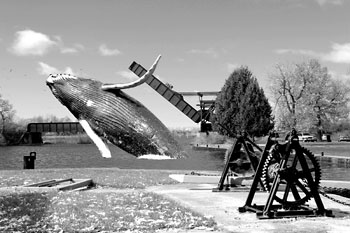
latest edition opens with an article about the geological history of the region, including the mention of whale bones found at Smiths Falls. The article is illustrated with an extraordinary "photo" and caption which I hope they don't mind my republishing here. Ken Watson obviously has a sense of humour.
 |
Humpback Whale at Smiths Fall Detached Lock The rare sight of a humpback whale breaching in the basin just above the Smiths Falls Detached Lock. This large animal has a gentle nature and is always respectful to Rideau boaters.
Whale photo - NOAA, Smiths Fall Detached photo - Ken Watson |
An extract from the article:
... In 1883, gravel to be used as railway ballast was being excavated from the Welsh gravel pit, about 5 km north of Smiths Falls. Workers in the pit came across several large bones. Word of these bones came to the attention of J.W. Dawson of McGill University, a geologist who specialized in this sort of thing. He collected the bones and they were later identified as being pieces of a vertebrae and a rib of a humpback whale (Megaptera novaeangliae). Later investigators found bones of beluga whales (such as those in a gravel pit at the northern edge of the Ottawa airport), marine clams and other evidence of a moderate saltwater environment that existed in this area at the end of the last ice age.
This saltwater environment was the Champlain Sea, formed about 13,000 years ago as the glaciers continued their retreat over the depressed landscape. Waters from the Atlantic Ocean mixed with glacial melt-waters and river drainage to create a brackish sea which extended past (west and south) of Ottawa. The southern limit of this sea on the Rideau Canal was near Nobles Bay of Big Rideau Lake. And, at that time, beluga whales, and at least one humpback whale, were swimming over what is the Rideau River today. That same sea is also responsible for the deposition of the famous (or infamous) Leda clay – the unstable “quick clay” that underlies large areas near Ottawa (and some other parts of eastern Ontario)...