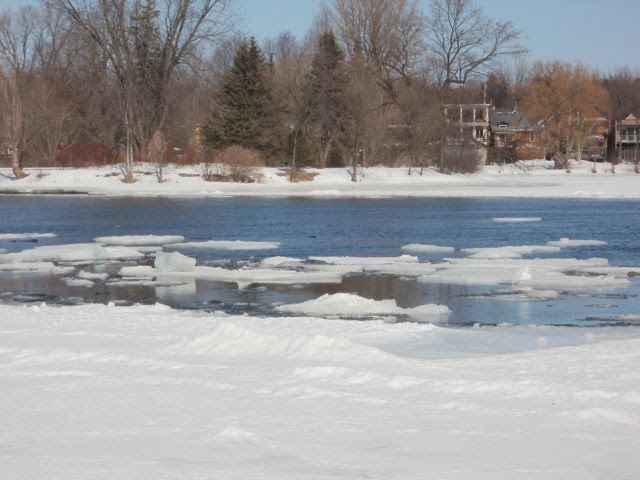
This month's ice-clearing operations on the Rideau River, upstream from the Rideau Falls, have so far only reached as far as the Chinese Embassy. As usual, dynamite was used first, then the amphibious excavator, but it's taking more time than usual because the ice is so thick this year and because the ice is piling up to a huge extent at the base of the falls.
I took some photos yesterday:
Showing posts with label Amphibious Excavator. Show all posts
Wednesday, March 19, 2014
Ice-breaking: a slow process
Labels:
Amphibious Excavator,
ice blasting,
Rideau Falls,
Rideau River
Saturday, March 8, 2014
They've begun
The ice-breaking crews have sprung into action on the local rivers. The amphibious excavator has created a semicircle of ice floes beneath the Rideau Falls and this morning my husband 'phoned to warn me that the bridge on Sussex Drive across the Rideau River was being closed, so that the dynamiting operations could begin just above the Rideau Falls. As the Minto bridges are also closed at present, this means quite a long detour for people wanting to access the Rockcliffe Parkway.
Anyhow, they have a nice, bright day for it. Windy, but sky clear.
Monday, March 18, 2013
Ducks are back
I always assumed that the ice breaking operations on the Rideau River finished just upstream from Cummings Bridge, where the rapids are, but today I caught a glimpse of the Amphibex well beyond that point, and the "growlers" that have been artificially broken off the main body of ice continue to sail down the river towards the falls.
We went to look at the falls at the weekend, very full now and with huge chunks of ice splashing into the river below. It's a dramatic spectacle. The mere picture above cannot convey the noise, the dampness from the spray, the smell of the river water, and the dizziness you feel standing on that bridge and watching all that water in rapid motion just below you. Compare the picture above with the one taken on March 3rd and you can see how much ice on the falls themselves has been dislodged by the sheer force of the water during the last couple of weeks.
It hasn't taken the local ducks long to find the water that's been cleared. I think we saw nine goldeneyes near our house, but what do they find to live on? The freshwater shrimps and the weeds below the surface, I assume. It must be extremely cold in the water, just now.
If you're interested in spotting birds, by the way, there's a list of recent sightings on this page of the Ottawa Field-Naturalists' Club website.
![]() |
| Rideau Falls, March 2013, photo by Chris Hobbs |
If you're interested in spotting birds, by the way, there's a list of recent sightings on this page of the Ottawa Field-Naturalists' Club website.
Thursday, March 7, 2013
Ice-smashing, continued
Yesterday, the Weather Network published an article about the removal of ice from the Rideau River. Here's an interesting statistic from it:
This year I see that the river men have been making a sort of rectangular grid of trenches on the melting surface to facilitate the break-up of the ice. It looks like a giant game board, with the Amphibex and its workers working from rectangle to rectangle as it slowly makes its way from one side of the river to the other. By the end of today, they'll be past our house.
Prior to the Amphibex's introduction, as much as 8,000 kilograms of dynamite would be used, scarring the riverbed and killing some wildlife. Today, only between 700 and 1,500 kilograms is used, limiting the damage.The task costs something like $500,000, apparently. Another fact I learned for the first time from this article was that the"annual ice-smashing exercise in Ottawa has been in effect for more than a century."
This year I see that the river men have been making a sort of rectangular grid of trenches on the melting surface to facilitate the break-up of the ice. It looks like a giant game board, with the Amphibex and its workers working from rectangle to rectangle as it slowly makes its way from one side of the river to the other. By the end of today, they'll be past our house.
Sunday, March 3, 2013
Blasted ice again
I don't mean the icicles that hang by the wall in the melt-freeze-melt-freeze sequence that always occurs at this time of year. I refer to the rivers––it's happening again: they are dynamiting the ice near the bridges on Sussex Drive and the Minto Bridges, just above the Rideau Falls. Yesterday, in fact, a section of Sussex Drive was closed all day during these operations.
Our house shakes and rattles from the explosions. We watched the operations for a while today, three sticks of dynamite being used at a time, and then the ice floes slowly move away from the continuous river ice towards the Falls where they break into fragments as they tip over.
The "nibbler," as my husband calls it, meaning the amphibious excavator which I have featured in this blog before, has been at work on the Ottawa River below the Rideau Falls, making room for the extra ice that's coming over. This year a reporter on the CBC radio program, Ottawa Morning, Hallie Cotman, had a ride on the amphibex. From the recording you can hear how noisy the machine is. The reporter also sounds rather nervous, on board. The crew teased her!
Our house shakes and rattles from the explosions. We watched the operations for a while today, three sticks of dynamite being used at a time, and then the ice floes slowly move away from the continuous river ice towards the Falls where they break into fragments as they tip over.
![]() |
| The Rideau Falls, this morning, photograph by Chris Hobbs |
Tuesday, March 8, 2011
Flood risk
The Amphibex, entering the water from Stanley / New Edinburgh Park has been working its way slowly upriver towards the Chinese Embassy these past two days, while the sun has shone from a very blue sky, making the expanses of ice and snow quite dazzling.
Over the weekend, we had relentless rain, later turning to snow; during the rainy phase conditions were ideal for ice-dams to form on the roof and cause leaks (enough water in our basement, for example, to require the removal of two large chunks of "dry wall" and insulation as well as part of the flooring—repairs and renovations to follow). The nuisance is relative. As recently as the 1980s, there had been worse to fear from the thaws in Ottawa: floods piling loose river ice high along the banks of the Rideau and, in the breaches, water that swept into houses several hundred metres from the river itself, sometimes completely submerging parked cars, and trickling in under people's doorways.
The drainage area of the Lower Rideau watershed covers 800 square kilometres. These days, the Rideau Valley Conservation Authority carefully maps the area and calculates the potential for flooding in order to help keep all this water under control.
Over the weekend, we had relentless rain, later turning to snow; during the rainy phase conditions were ideal for ice-dams to form on the roof and cause leaks (enough water in our basement, for example, to require the removal of two large chunks of "dry wall" and insulation as well as part of the flooring—repairs and renovations to follow). The nuisance is relative. As recently as the 1980s, there had been worse to fear from the thaws in Ottawa: floods piling loose river ice high along the banks of the Rideau and, in the breaches, water that swept into houses several hundred metres from the river itself, sometimes completely submerging parked cars, and trickling in under people's doorways.
The drainage area of the Lower Rideau watershed covers 800 square kilometres. These days, the Rideau Valley Conservation Authority carefully maps the area and calculates the potential for flooding in order to help keep all this water under control.
Sunday, March 6, 2011
Thursday, March 3, 2011
Stuck in the ice!
Amphibious excavators, or water diggers, as I called one last year when I wrote a story about it for my 3-year old grandson (now 4), are used in Ottawa's efforts to break up the ice on the Rideau River. I gave my fictional one a name, Arnie Amphibex.
The deployment of these amphibious vehicles is an alternative to the use of dynamite during the ice-breaking process, less harmful to the creatures in the river. We joke about the beavers and muskrats waking up with a headache when the explosions happen, but it isn't funny for them or for the fish.
Tuesday night, two "Arnies" were on the Ottawa River near the Rideau Falls, where a significant amount of broken ice from the Rideau River is now accumulating. It was night when we spotted them; one machine was lit up and working slowly and steadily, downstream from the falls. The other one, upstream of the falls, could hardly be seen because no light was on in its cabin. It seemed to be wrecked, wedged in the jagged ice. Curious, I went back next morning and saw that the vehicle was stuck indeed, still immobile in the same place, partly submerged, as my photo at the top of this blogpost shows, and presumably abandoned. The other Amphibex was no longer to be seen.
Public access to the footpath across the falls bridge was prohibited yesterday, but I found an impressive view from the lookout point to the side.This morning, Thursday, there's an Amphibex poised to enter the Rideau River upstream from the falls, at the point where the ice-breaking team have stopped dynamiting. I haven't checked to see whether the wrecked one has been salvaged yet.
Subscribe to:
Posts (Atom)