Monday, March 14, 2011

A national disgrace

Entrance to the disused Pavilion
This building, opened in 2001, has been closed since 2005, abandoned; for those four years it housed a "permanent" Canada and the World exhibition which, according to the pundits, nobody wanted to visit. On the contrary, in my case. I used to go there regularly, bringing my guests from overseas. It doubled as a venue for diplomatic receptions, etc. I went to a couple of those too, and very pleasant it was, to spend time in the light, airy upstairs room or on its balcony overlooking the adjacent Rideau Falls, the Ottawa River and the Gatineau Hills beyond. You could spend a relaxing hour watching the boats and the sunset from that balcony, a glass of champagne in your hand.

 The Pavilion in profile, showing its viewing balcony
These days, the building is already falling into a state of dilapidation, with rusty pillars and the danger of "toxic mould" forming on its damp inner surfaces.

After World War II, the land on which it stands was acquired by Public Works and Government Services Canada and, more recently, leased to the National Capital Commission.

50 Sussex Drive is one of the most under-utilised prime sites in the capital, a ridiculous waste of space. In 2007 it was considered as a potential  Embassy or High Commission, but this option would limit public access to the lookout over the river (coach loads of tourists regularly wanting to stop and see the Falls) or to the pleasant gardens round about. A monument to Canadian foreign aid workers who have perished in the course of their work is a few paces away, and it wouldn't be right to prevent people from seeing that. There's an outdoor display of ceramic tiles here as well, a reminder of the "cultural and artistic treasures of the Ottoman Empire"—a gift from the Iznik Foundation and the Turkish Embassy.

The pavilion, when it closed, also became a possible new location for the Ottawa Art Gallery, presently on Daly Avenue, but that idea came to nothing as well, perhaps because of the above-mentioned mould problem.

Before the newer pavilion was erected, a one storey, stone structure housed the Canada and the World collection. As new immigrants, we found it an interesting but strikingly small-scale affair, with a snack bar and washrooms at the back, only accessible from the outdoor patio.

The Virtual Tourist website published a comment in April 2003 that throws some light on why the showcase was a failure:
"I thought this museum was a pat-yourself-on-the-back place to re-enforce what people already knew. Mentally, I place the Canada and World Pavillion somewhere in between "kinda/maybe" interesting and an example of the dreaded Canadian inferiority complex [...]  If you really do want to see all the pictures of famous Canadians, see Canadian inventions, Canadian sports, Canadian technology, Canadian footballs, Canadian...ummm...trade relations with EU and U.S., then please come. But if you're not Canadian like myself, you might be bored out of your mind." 
I too remember thinking in the early days of living here: these Canadians are too diffident by far. Visitors were encouraged to make suggestions for the additional display of exemplary Canadian names in the Millenium Year and I filled out a card suggesting Richard Margison, the opera singer (my mother's cousin's son).

If I had a say in the matter, I'd propose that the location become the site of Canada's presently non-existant National Portrait Gallery. I'm sure something could be done to stop the damp seeping in, if the political will were there. The fact that we don't have such an attraction / historical record in our capital city (as does Australia, in Canberra, for example) is another national disgrace.

The Rideau Falls

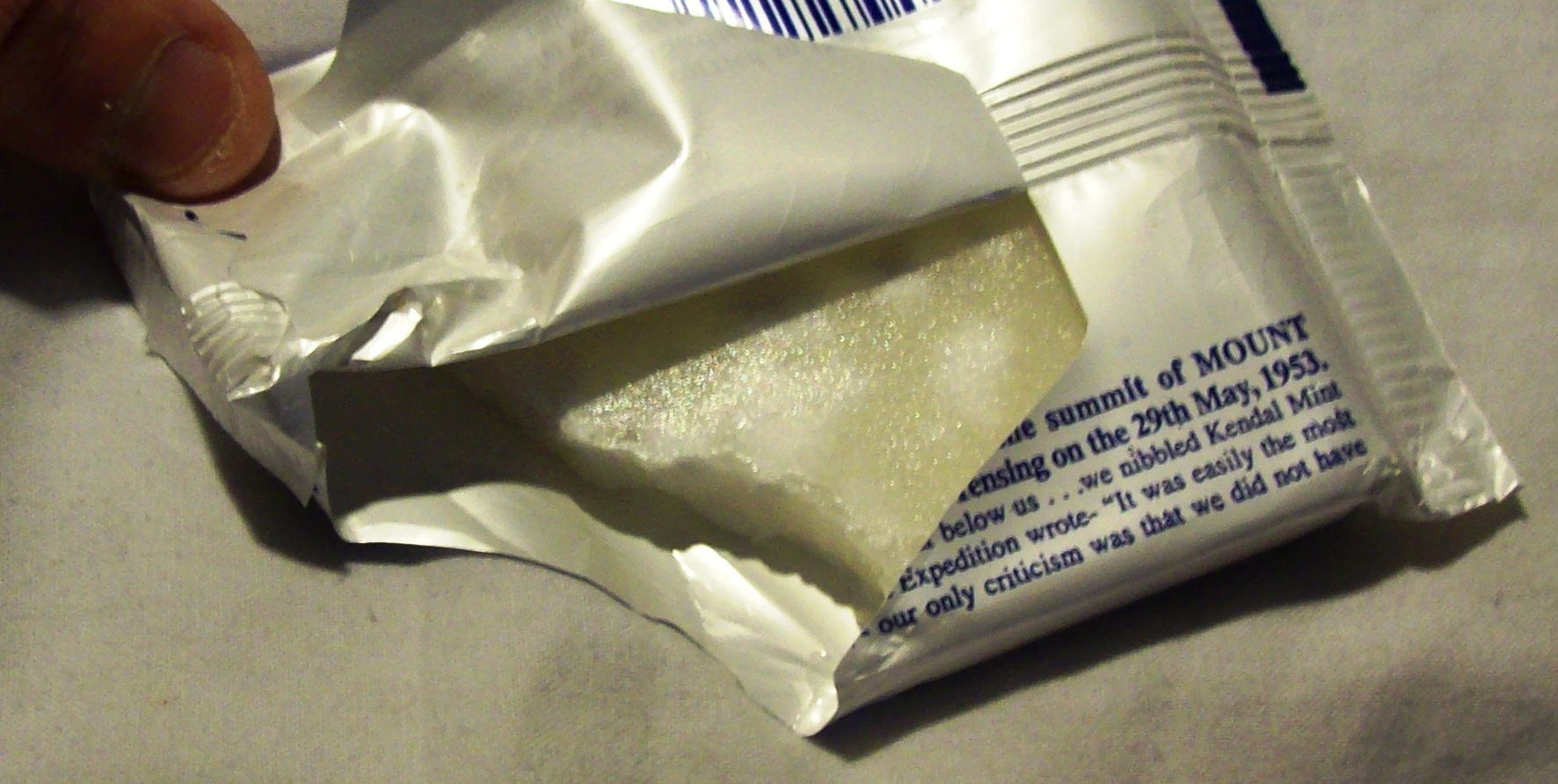
When we first arrived in Ottawa from the UK I used to think that the ice floes tipping over the Rideau Falls looked like giant chunks of Kendal Mint Cake. We paused a while yesterday to watch some of this years' ice reach the lip of the Falls and splash down below. A group of people were doing the same on the opposite bank and shouting "Oh!" as the larger pieces hit the Ottawa River with a splash. Perhaps the sight was new to them; it's certainly dramatic. This year is the first time that I recall the bridge across the Falls being ribboned off: no public access. If you stand there watching the full spate of water, it makes you dizzy, and if there's a wind from the northwest, the spray blows up and wets you.

Rideau Falls, 1860 (no public safety measures, in those days!)
The hydro energy used to be harnessed by a series of mills (grist mill, wool mill, saw mill), built by Thomas MacKay, who first saw its potential in the 1820s. MacKay (sometimes spelled McKay) is also famous for having built the mansions Rideau Hall, eventually the official home of the Governor General, and Earnscliffe, now the British High Commissioner's Residence, overlooking the Ottawa River upstream from the Falls.

In our day there's a small hydro-electric station with two turbines beside the Falls which has been in service since 1908 and which generates 8542 MW of power per year.

Saturday, March 12, 2011

Ice passing Porter Island

The temperature's above zero, it's cloudy but not raining and the Amphibex is as far upstream as Cummings Bridge. That's progress. This afternoon, as we walked towards the Rideau Falls—brown water in full spate!—I could smell the river. Heard and saw ducks on it, too.

Following the current of the river, the pieces of ice broken off by the Amphibex, but not into such large chunks as I've seen in previous years, are making their way to the falls. Beneath the falls the pile of ice is spreading, dirty with foam around the edges. The other (?) Amphibex is no longer trapped in that area. Pools of water are forming in the riverside parks, not to mention the puddles on streets and sidewalks. Slush everywhere.

In my picture the ice is floating between Porter Island and the Bordeleau Park bank. In 1913, there was a smallpox isolation hospital on this island. Nowadays it is where the elderly live, either in one of the most prestigious and expensive retirement residences in town, The Rockcliffe—it offers one or two bedroom and studio apartments, a luxurious lounge "with a panoramic view of the river," a library, a spa, a theatre, a dining room opening out on to the gardens with a and patio area and a limousine to take the residents anywhere they want to go—others live in the building opposite, on the other tip of the island, the nursing home.

Tuesday, March 8, 2011

Flood risk

The Amphibex, entering the water from Stanley / New Edinburgh Park has been working its way slowly upriver towards the Chinese Embassy these past two days, while the sun has shone from a very blue sky, making the expanses of ice and snow quite dazzling.

Over the weekend, we had relentless rain, later turning to snow; during the rainy phase conditions were ideal for ice-dams to form on the roof and cause leaks (enough water in our basement, for example, to require the removal of two large chunks of "dry wall" and insulation as well as part of the flooring—repairs and renovations to follow). The nuisance is relative. As recently as the 1980s, there had been worse to fear from the thaws in Ottawa: floods piling loose river ice high along the banks of the Rideau and, in the breaches, water that swept into houses several hundred metres from the river itself, sometimes completely submerging parked cars, and trickling in under people's doorways.

The drainage area of the Lower Rideau watershed covers 800 square kilometres. These days, the Rideau Valley Conservation Authority carefully maps the area and calculates the potential for flooding in order to help keep all this water under control.

Thursday, March 3, 2011

Stuck in the ice!


Amphibious excavators, or water diggers, as I called one last year when I wrote a story about it for my 3-year old grandson (now 4), are used in Ottawa's efforts to break up the ice on the Rideau River. I gave my fictional one a name, Arnie Amphibex.

The deployment of these amphibious vehicles is an alternative to the use of dynamite during the ice-breaking process, less harmful to the creatures in the river. We joke about the beavers and muskrats waking up with a headache when the explosions happen, but it isn't funny for them or for the fish.

Tuesday night, two "Arnies" were on the Ottawa River near the Rideau Falls, where a significant amount of broken ice from the Rideau River is now accumulating. It was night when we spotted them; one machine was lit up and working slowly and steadily, downstream from the falls. The other one, upstream of the falls, could hardly be seen because no light was on in its cabin. It seemed to be wrecked, wedged in the jagged ice. Curious, I went back next morning and saw that the vehicle was stuck indeed, still immobile in the same place, partly submerged, as my photo at the top of this blogpost shows, and presumably abandoned. The other Amphibex was no longer to be seen.

Public access to the footpath across the falls bridge was prohibited yesterday, but I found an impressive view from the lookout point to the side.

This morning, Thursday, there's an Amphibex poised to enter the Rideau River upstream from the falls, at the point where the ice-breaking team have stopped dynamiting. I haven't checked to see whether the wrecked one has been salvaged yet.

Tuesday, March 1, 2011

The Unity Tower

The Rideau River, March 1st, 2011
There go the ice floes under the Minto Bridges and past the "Unity Tower." The river is visibly moving along once again after another day of blasting, the explosions audible as dull thuds from inside my house. (Strangely enough, during last year's earthquake in mid-summer, centered 60 km north of here, I heard a similar explosive noise.)

Regarding the "Unity Tower" (symbolic of the union of English- and French-speaking Canada) there's a story behind it (this version's in the Wikipedia, describing the architecture of 111, Sussex Drive):
In 1988 Ottawa mayor Jim Durrell initiated a controversial scheme to expand the building, quadrupling its original size. Architect Moshe Safdie was chosen for the redesign. Conflict soon broke out between Safdie and the city. Safdie demanded a higher fee and delayed the project for several months before the city acquiesced to his demand. Then a conflict broke out over a pair of eighteen story observation towers. City council voted to cut the towers to save the million dollars they cost. This infuriated Safdie who felt the towers were essential to the design. The panel that picked the design had singled out the tower as one of the highlights of the design. Eventually the city compromised and a bare scaffold was erected.
This story was going stale by the time when we moved to Ottawa in 1995, but the Quebec referendum of that year caused some more excitement, and in the heat of the moment someone boldly and illegally climbed the scaffold to hang a huge Canada flag at the top, from the symbolic "bridge" between the tower's two supports.